
Athens
Greek people look like Italians but more attractive and Greek food tastes like Middle Eastern food but worse.

Peisin and I found ourselves in a Dark Wave/Goth bar named Teddy Boy in the new touristy area of Athens (Psirri), which is a two minute walk from the old touristy area of Athens (City Center). In this bar there was a decked-out-from-head-to-toe goth girl. She sat at the bar’s open front window making out with a large guy with a man-bun who wore an outfit that would be right at home on a hiking trail. Meanwhile, the bar’s punk waitress sat smoking cigarettes with two soccer hooligan types. All of these men were tall and totally ripped.
The next day I passed a group of metalheads loitering outside of the Thissio subway station. I hooked a left, entered a park and stumbled upon two of the largest skinheads I have ever seen (“The Business” and “Sham 69” shirts respectively). This begged the question: are the punk men of Greece just physically larger than the alternative men of the United States? Coming from my world of little NYC indie-rock twinks, these Athens guys looked like a crew of gym bros.
When I proposed that Peisin and I visit Athens I had no idea there would be punks in this city. Honestly I knew nothing about Athens except that it is older than Rome. I love history and Rome was the oldest historical site I had been to. Getting to glimpse the Colosseum was one of the most thrilling sights of my life but, history aside, Rome’s a drag. In Rome I saw no youth art culture, no alternative culture of any kind. Walking around I never passed a person that I immediately wanted to be friends with. But Athens, that’s another story.
* * *
The Americans with Disabilities Act has ruined New York City! Where’s our cafes with cute little winding staircases that take you down to the smallest bathroom you’re ever seen? Where’s our adorable little streets with sidewalks not wide enough for two people to pass without one stepping into the road? Where’s our alleys?!?!?
(ADA might not have been responsible for this last one)
The touristy downtown of Athens was not built with cars in mind. Thin streets cross each other at weird angles, cars park on top of the almost non-existent sidewalks, one scooter whips by after another but, mainly, it’s just outdoor seating everywhere.
Restaurants are trying to take over territory. They start with seats in front of their establishment and then, when the store across the street closes for the night the restaurant adds more tables over there. After the business next door rolls down its graffiti covered gates the restaurant’s tables begin stretching in that direction and then the restaurant puts two standing tables in front of a catty corner bookstore just for good measure. Soon every one of these tables is flush with people.
Since the appearance of Covid-19 New York City has been trying to capture this outdoor dining mystique with its “NYC Open Streets.” Restaurants are allowed to put outdoor seating in the parking spaces in front of their establishment. Occasionally, steel barricades are used to stop cars from using certain roads during peak dining hours. NYC has strict rules about how many seats each restaurant is entitled to. They also require water-filled barriers, each weighing 675 to 1,300 pounds, to wrap around all three street facing sides of the outdoor patrons. Athens, on the other hand, does not give one single fuck if outdoor diners live or die.
A cab is stopped in the middle of Protogenous Street in Psirri trying to figure out how to get around crowded tables that spill from a restaurant and fill the thin road. It is 10pm. Half of the patrons sit with only a cocktail in front of them while the other half have just begun dinner. (Athens is a late night town and 10pm dinner is considered early.) Eventually the cab relents, backs up half a block and drives the wrong way down a side street to get out of this stand-off.
* * *
Peisin and I push our way through a crowded alley in the neighborhood of Exarchia. It’s 9pm on a Saturday and hundreds of people sit at tables drinking beer and cocktails served by five bars that stretch the length of the alley. Mixed in with these patrons are teenagers downing cans of beer while slouching on curbs and ledges. In Greece the drinking age is eighteen and there are no open-container laws so all of this is above board. Even with hundreds of seats Peisin and I struggle to find an empty table. We walk to the next alley and it’s more of the same.
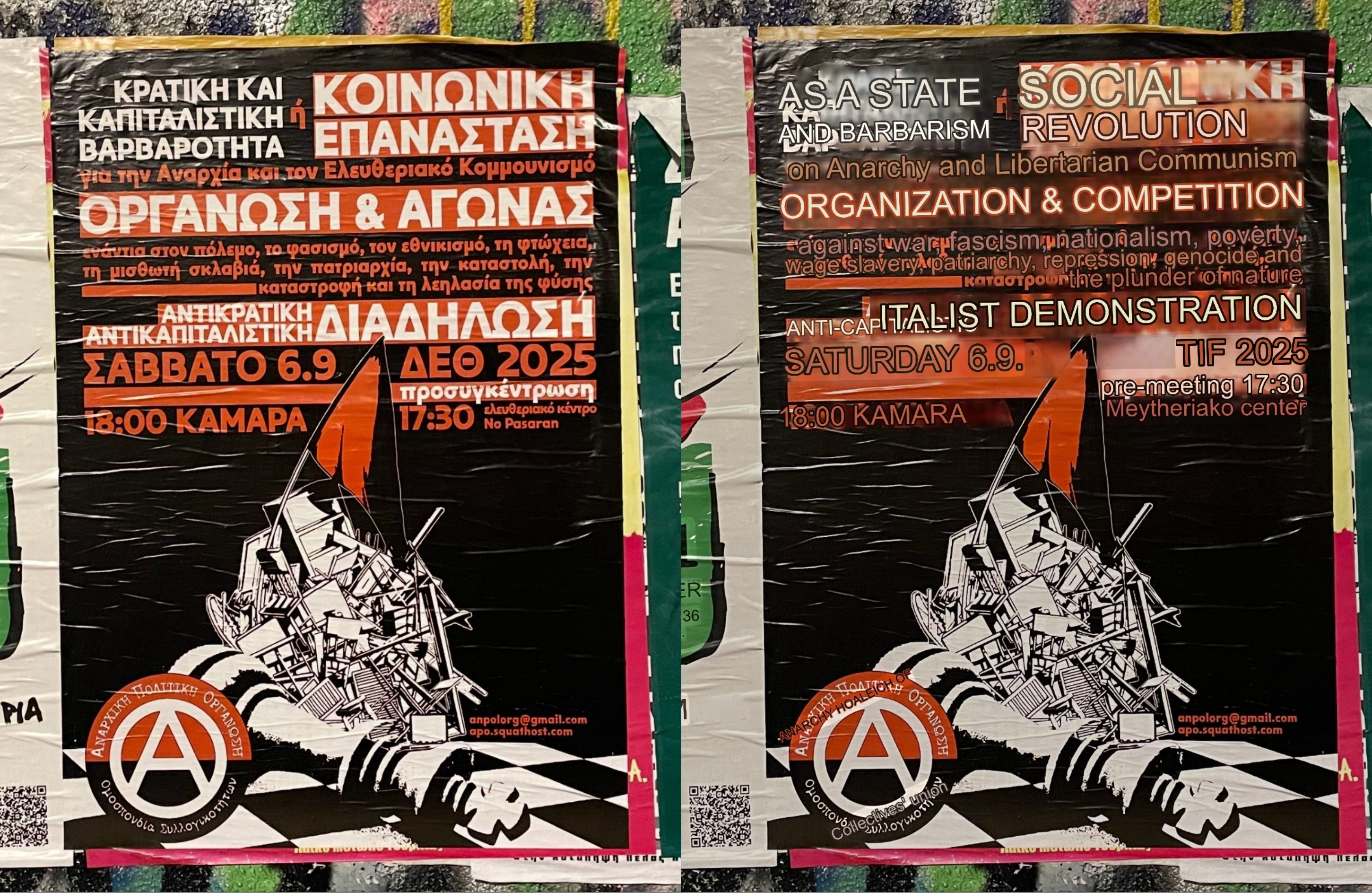
Earlier that evening a crowd of protesters marched down Panepistimiou street and ended their parade in this neighborhood. Wheat pasted signs explain that it was an anti-capitalist demonstration “against war, fascism, nationalism, poverty-wage-slavery, patriarchy, repression, genocide, and the plunder of nature,” so kind of a general protest, I guess. Everywhere we’ve been in Athens has been pretty punk so it’s hard to say how different this crowd would look on another Saturday but, based on my one night in Exarchia we have discovered the anarchist Valhalla.
Peisin and I turn down a third alley and, as the tables taper off we discover 30 yards of alley without businesses. In this area a huge collection of black clad punks are bouncing off one another in post-protest excitement, goofing around, each trying to be the center of attention. Peisin stops and says she’s not dealing with all of that. I try to explain that they won’t hurt us. “Anarchist punks are pussies,” I say but Peisin’s not listening, already walking the other direction.
In a fourth alley I drink a Jameson and soda and then we find a late night burrito place serving the drunk crowd. There are young artists everywhere and Exarchia looks as if you took every customer in every youth oriented bar in Bushwick and made them all sit outside together in a dozen charming alleys.
Around midnight we take a cab back to our hotel and as the car pulls out of Exarchia we see a few dozen police meekly loitering on a sidewalk where they’ve been stationed since the protest ended. Suddenly two cops break away from this group and start hurrying into Exarchia with their batons drawn. They look ready to bust skulls but I’ll never know what happens because our cab takes a corner and the police are beyond my view.
* * *
If you drew a circle around City Center, Psirri and Exarchia it all could easily fit inside the borders of Williamsburg, Brooklyn. This is the main tourist hub of the city, making a semi-circle around the north side of the Acropolis, and any healthy person could easily walk from one end to the other. Athens has a similar population to Seattle (a little more than three million in the greater urban area) but Athens has one fifth the landmass of Seattle so it’s pretty densely populated. The city stretches on but in our four day visit we never left the neighborhoods I just mentioned so that’s all I’ll be writing about here.
* * *
In City Center there is a thousand year old church named Panagía Kapnikaréa. The church is tiny, it has no pews, standing room only. It was built around 1050 CE on top of an existing Greek temple. As Peisin and I approached the church there was a man outside ripping rock solos on an electric guitar. He had a battery powered amplifier and a drum machine keeping the beat. He was in his twenties and made up the riffs as he went. A few tourists talked to him as he played. He noodled in front of this Byzantine church that rests in the middle of a modern street, a street lined with such stores as Zara, Foot Locker, Guess and a bunch of European chains I didn’t recognize. Peisin and I kept moving.
After passing the Roman Agora (overlooked and scoffed at for being built only 2000 years ago as opposed to the 2400-year-old Greek structures) we arrived at Ifestou Street. This is a thin row of mostly one to two story buildings housing a variety of independently owned shops. A hiking goods store, army/navy store, cheap jewelry shops, a great used record store, stores specializing in hats or shoes or flowing hippy attire suited for the most devoted wook. But what really caught my eye was no less than three stores dedicated to punk, metal and rock t-shirts. Ninety-nine percent of the shirts inside these establishments were black. Two of the stores featured racks of baggy nu-metal bondage pants. Studded bracelets sat inside a glass case. It was like a collection of independently owned Hot Topics (circa 1998) comfortably nestled into the birthplace of democracy.
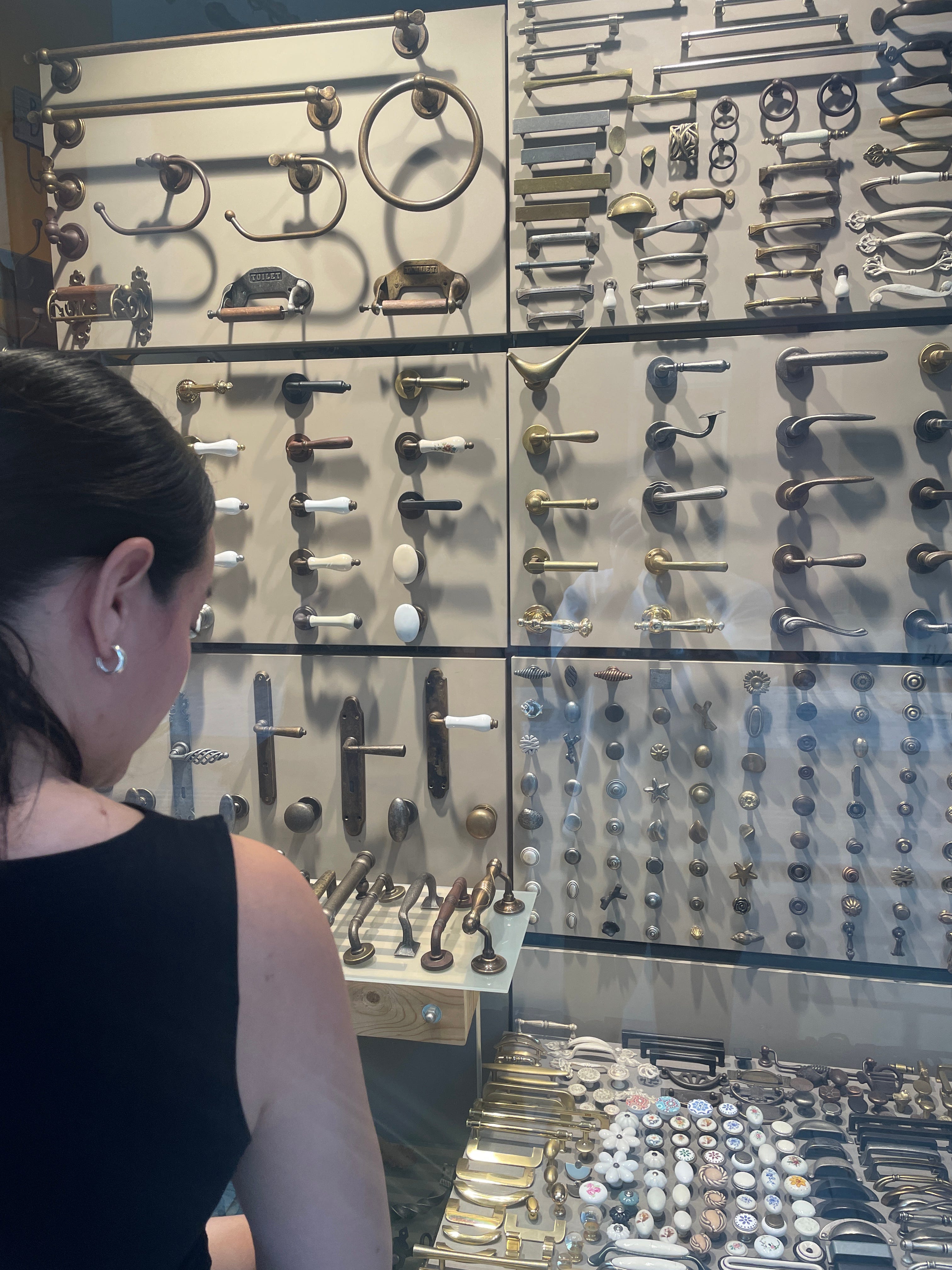
As for Peisin, it wasn’t the chain stores or punk stores that excited her but, walking through Psirri, I’d occasionally hear her gasp. Inevitably we’d be standing in front of a shop that sold only one thing. The “thing” varied. The point was that it sold nothing else. A little shop that only sold buttons (arranged in order of color). A corner store that solely peddled lamp shades. I thought Peisin was going to keel over dead, overwhelmed by beauty when we stumbled upon a store that exclusively dealt in vintage door knobs.
Navigating the shops in City Center and Psirri was easy because at least half of the signage is in English. Tourists from all over Europe use their broken English as the common language while visiting Athens. Again, keep in mind we are talking about the most touristy area of the city, but the majority of employees I interacted with spoke English fluently. Because of this I regularly found myself thinking, “I could live here!” While I’ve had a similar feeling passing throngs of artists in Barcelona and Mexico City, in those Spanish speaking countries I knew actually moving there was just a daydream because communication was so difficult. If I can’t be funny or ask people deep, honest questions what’s the point of living?! But in Psirri, as Peisin and I ventured from bar to restaurant casually chatting with our servers and bartenders it felt like uprooting my life to the Mediterranean was a real possibility.
In fact, there were times when I forgot I was not in New York City. Graffiti covered everything. At least half of the employees at the vegan restaurant were lesbians. The cabs, bars and restaurants all played American music. The most European sound I encountered in Athens was a hip coffee shop in Exarchia (Behold Theman) playing the “Call Me By Your Name” soundtrack. While touristy restaurants do often feature acoustic three-piece bands playing live Greek tunes, it was clear that this wasn’t what your average citizen was listening to at home.
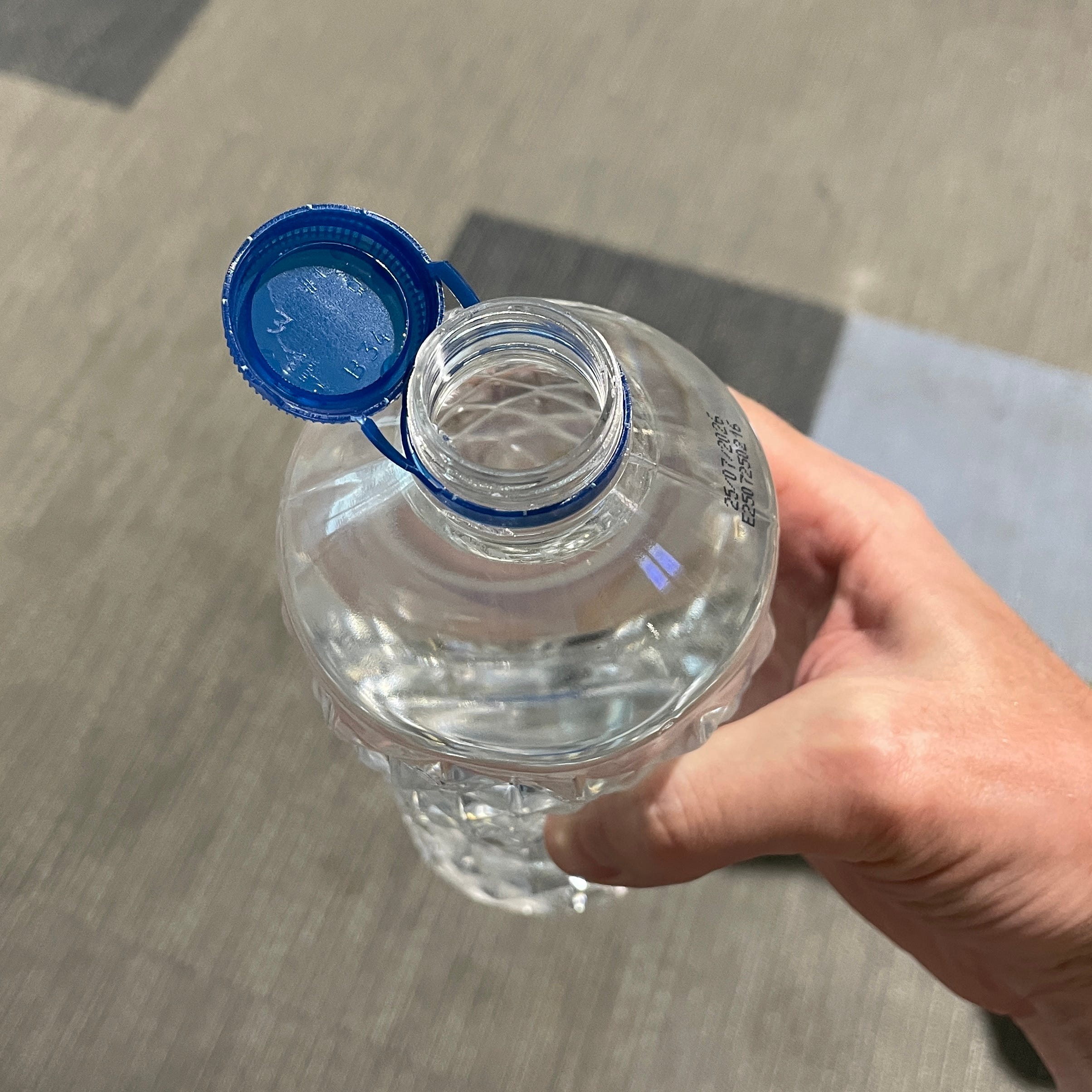
But, among the similarities were important differences. The toilet bowls are square. Caps to plastic water bottles do not come off but stay connected to the bottle’s safety-seal like a miniature Nalgene bottle (This was great. America should do this). Tips at restaurants must be entered before the credit card is run. But the real difference between Athens and American-walking-cities is the structure of the buildings and the climate.
In Athens there’s hardly any rain in the summer so very little vegetation grows. They only have shrubs and low, dry trees. While the longitude and altitude of Athens is similar to Virginia Beach, this lack of rain and vegetation results in higher temperatures (although it’s a dry heat). Peisin and I were there at the beginning of September and the temperature got into the 90s every day. The topography is long flat plains broken up by sudden, sharp stone mountains. This spring my family drove across New Mexico and, to me, Greece basically looked exactly the same, a lot of rocks and not much else. I checked if Greece is a desert and the internet says no, it says Greece has a “Mediterranean Climate,” which seems like a cop out. That’s like saying New England has a “New England Climate.”
Of course, this climate dictates supplies for construction. Nothing is built of wood because there are no large trees. Coming from New York City I’m accustomed to brick being the dominant building material but you’re not going to find a single brick structure in Athens. Everything is concrete poured over thin metal poles of rebar.
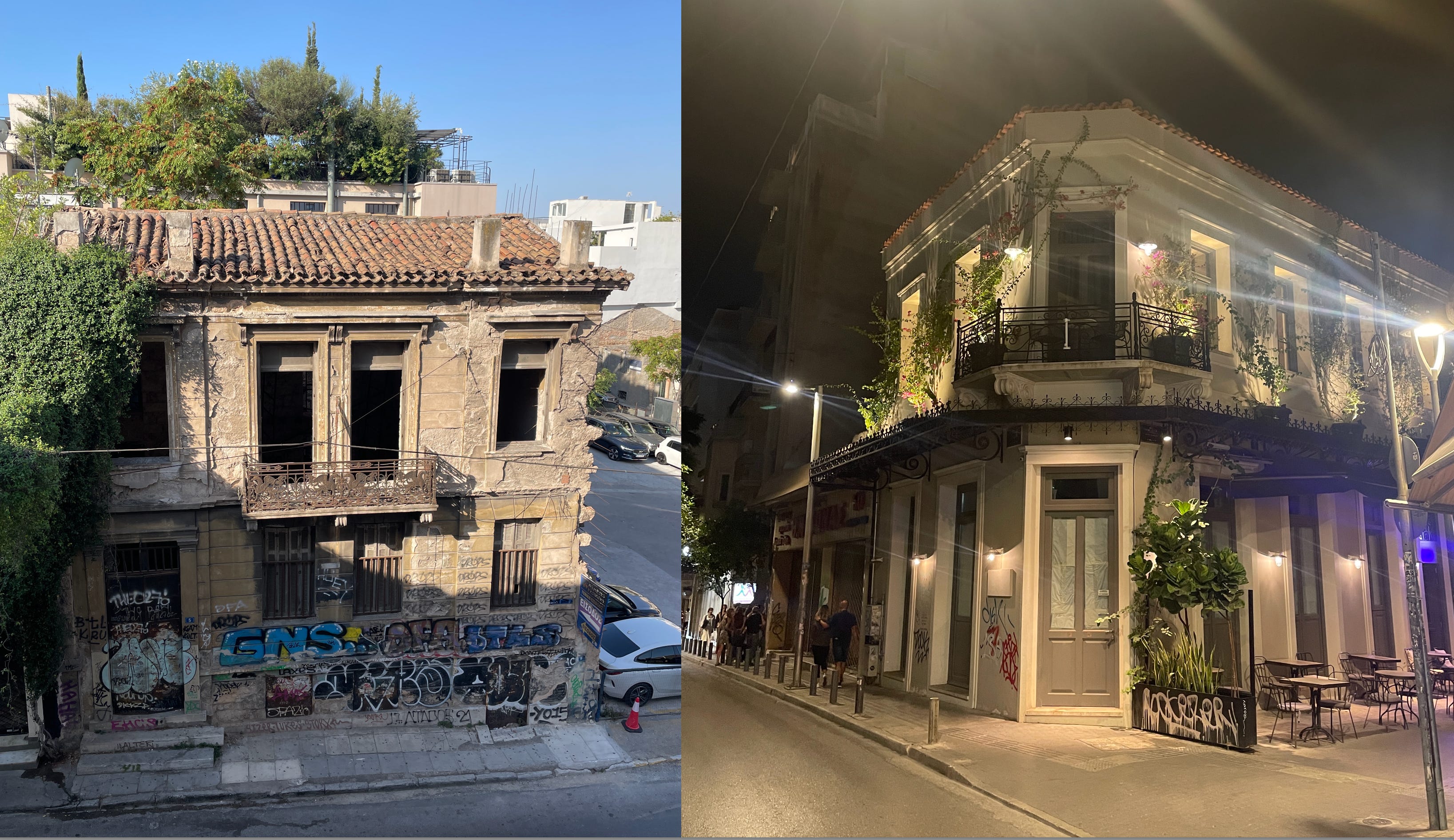
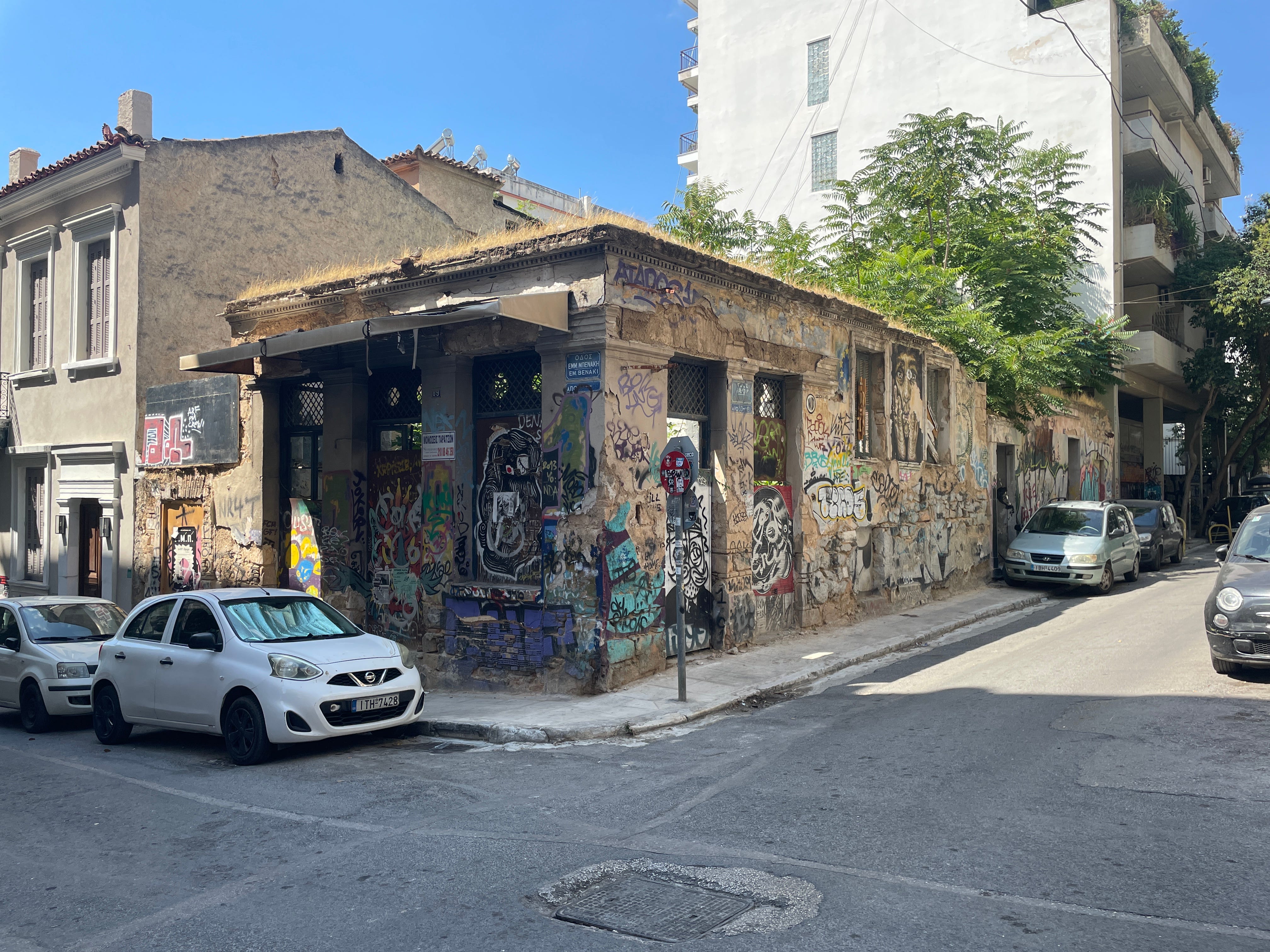
The older buildings are between one and three stories tall with cute balconies and clay tile roofs. The facades are often adorned with classical flourishes, stone shapes carved into the cement around the windows or across the entire wall. The poured cement facades are sometimes shaped to appear like large stacked stones but, as you pass old collapsing buildings you’ll see that it’s actually poured cement underneath.
Even as you walk through City Center there’s no shortage of small decaying buildings, moss growing from the clay roofs as the roofs themselves collapse. The way these buildings deteriorate is absolutely beautiful, nestled next to the outdoor dining, cement window frames ready to fall in someone’s lap.
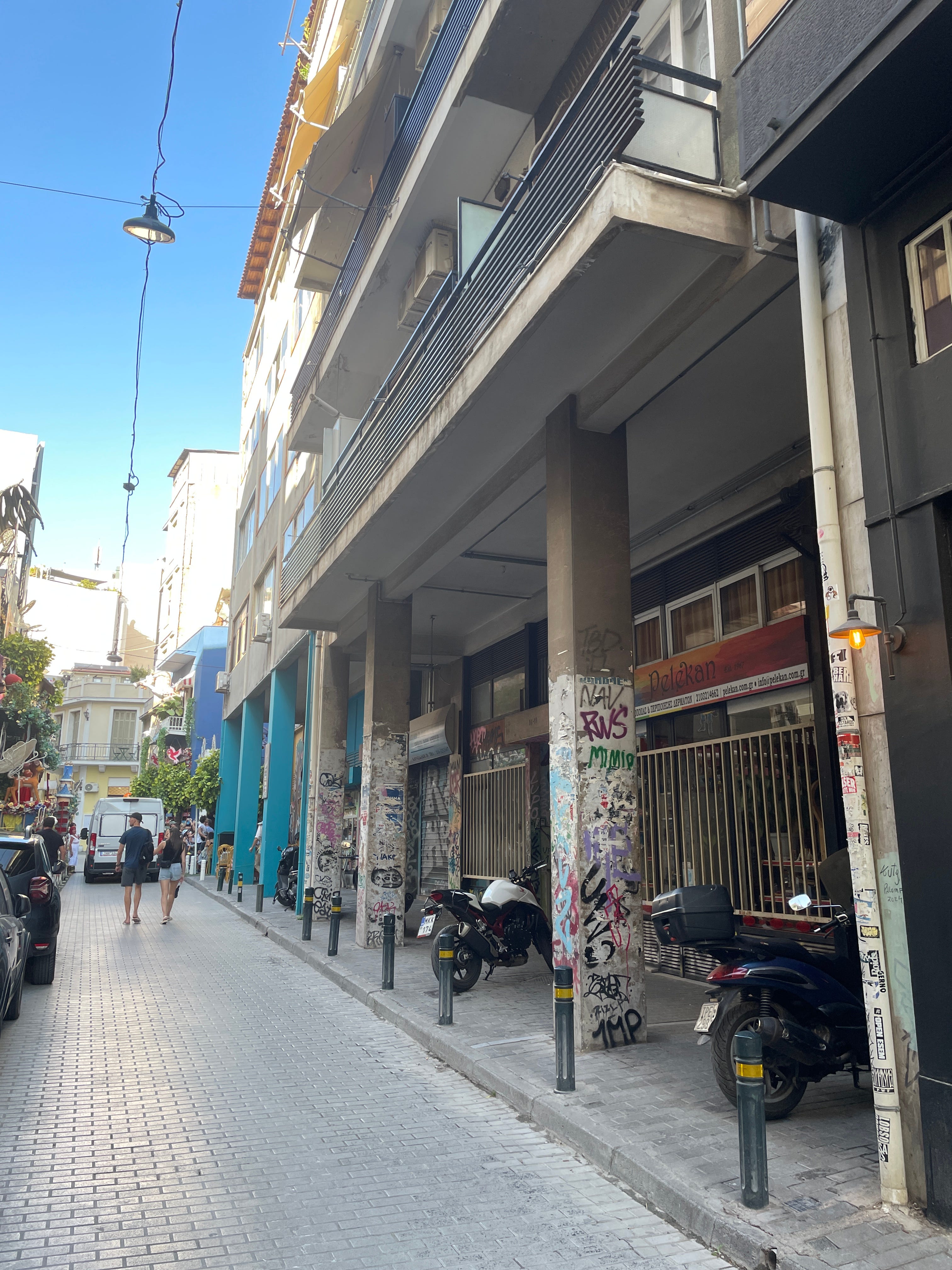
The newer buildings are four to six stories tall, also made of poured cement and rebar but the design is different. Very minimal. Very brutalist. It is a design I never see in the United States but I’ve been to Taiwan and Ecuador and everything in those counties is built in this fashion. There are rows of large rectangular windows that open by sliding sideways. Below each row of windows is an equally sized line of either cement or metal siding. Like the older buildings, these structures often have balconies, although the balconies are larger, more practical than cute. But the most defining characteristic of these new buildings is the first floor. In the ninety-five degree afternoon heat of Athens you want to avoid standing in the sun and that’s exactly what these newer buildings are designed for. The first floor almost always contains a store and that store is pushed back ten feet from the facade of the building, leaving an open-air walkway for people to stroll under. Here you sometimes find outdoor seating or an occasional parked car but mostly it is for pedestrian use.
I do not find these new buildings aesthetically pleasing (to me, they give an industrial-Florida vibe) but as they nestle next to the crumbling older structures on Athens’ thin streets they are charming and the real power behind this charm comes from the thin streets themselves.
The Commissioners Plan of 1811 put the streets of New York City in the grid we know today. It decreed that there would be no alleys between blocks and that east/west streets would be 60 feet wide while north/south avenues would be a whopping 100 feet. While these decisions allowed for better movement, superior fire protection and more light and air for the residents of NYC, there is a beauty in walking down a thin street which New Yorkers can only experience now if they travel.
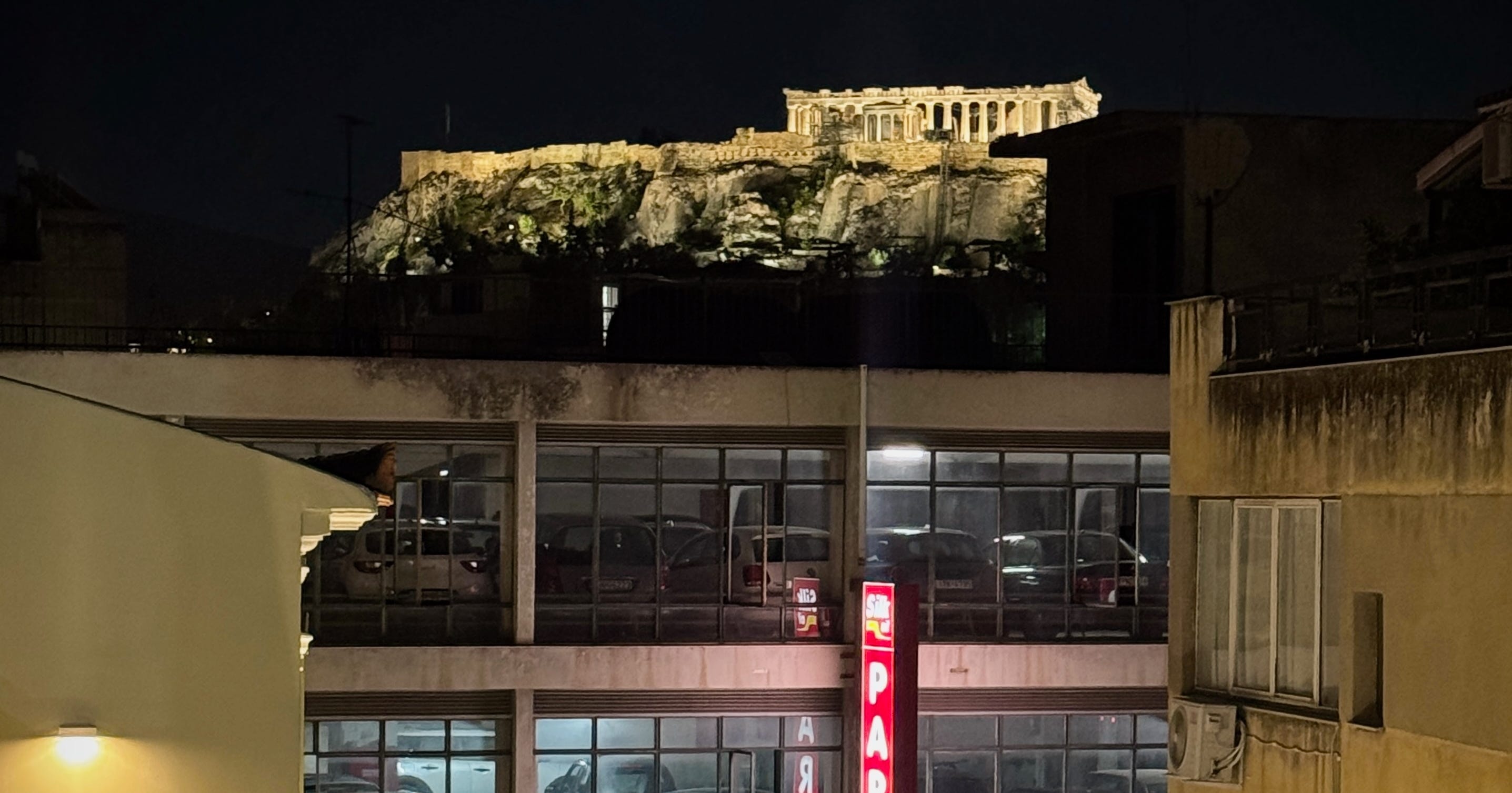
The areas of Athens that I visited were not idyllic. There was no shortage of abandoned buildings and empty store fronts. When I had occasion to get a good glance in a second story window it was surprising how often I found the room on the other side to be completely empty. But the streets were never empty, bustling with people walking from one outdoor restaurant to another. And every time I took a moment to look up, there it was, The Acropolis! Glowing day and night, a beacon over the city and the real reason why I came to Athens in the first place.
* * *
So let me end this piece with a short (and incredibly inaccurate) history of the Acropolis itself.
3000 BCE - Humans settle the land they will eventually name Athens. Someone says, “Yo, there’s a small mountain 3.1 miles from the sea and it would be a strategic location to fight battles from!”
1700 BCE - “Wait, if we carve the mountain so the sides are steeper our enemies will have a harder time getting up there to attack us!”
*starts shaping mountain*
SOME TIME LATER - “Just a minute, if we flatten the top of this mountain, the one we made with the steep sides, then it will be easier to walk around and see our enemies!” (no smartphones, lotta time on their hands)
580 BCE - “Hear me out, the gods love it when we build temples for them. What if we put one on top of that mountain that we flattened?!”
*builds original temple to Athena, named the Hecatompedon. The mountain is now an Acropolis, Greek word for “high city”*
530 BCE - “Incoming great idea guys, that temple to Athena looks sick as hell. Lets build more buildings on top of the flattened mountain!!!”
*builds another temple and five smaller buildings*
492 BCE - *Greece and Persia begin an epic 43 year war*
490 BCE - *Greece beats the shit out of Persia*
“Yo, everybody, we Greeks are amazing! And so good at battle!!! Let’s treat ourselves by taking apart the Hecatompedon and making it even better!”
480 BCE - “Oh fuckkkkk! We thought we had totally defeated Persia but now they came back and killed everyone and destroyed all of our buildings, including the new temple to Athena that we spent the last ten years building! NOOOOOO!”
447 BCE - A Greek statesman named Pericles says, “Get this, I have a lot of money that we’ve saved up for the Greek people but what if I misappropriated the funds and used a ton of it to rebuild the Acropolis!”
*The Parthenon is built where the Hecatompedon used to be*
ONE THOUSAND YEARS GO BY - *control of the Acropolis changes hands many times*
500 CE - “Hear ye, hear ye, Greek gods are stupid and dumb and we are making them illegal. This Parthenon is now a temple to the one Christian God!”
1458 CE - *Athens conquered by the Ottoman Empire*
“Just an idea, these Christian temples on top of the flat mountain could totally be used to worship our Muslim gods!”
1687 CE - “Hold up, we’re in the middle of a big war and our Muslim temple on top of the flattened mountain would be the perfect place to store gunpowder!”
ALSO 1687 CE - “Dudes, I heard the Ottoman Empire stored all their gunpowder in that temple they have up on their flat mountain, let’s set the inside of the temple on fire and see if it blows up!”
*Parthenon blows the fuck up. Completely destroyed*
And then in 1833 CE - “Crazy idea, but that blown up temple on top of that flattened mountain with the steep sides has been around for a looooong time. What if we made it a historical site?!”
FIN
BONUS SANTORINI STORY:
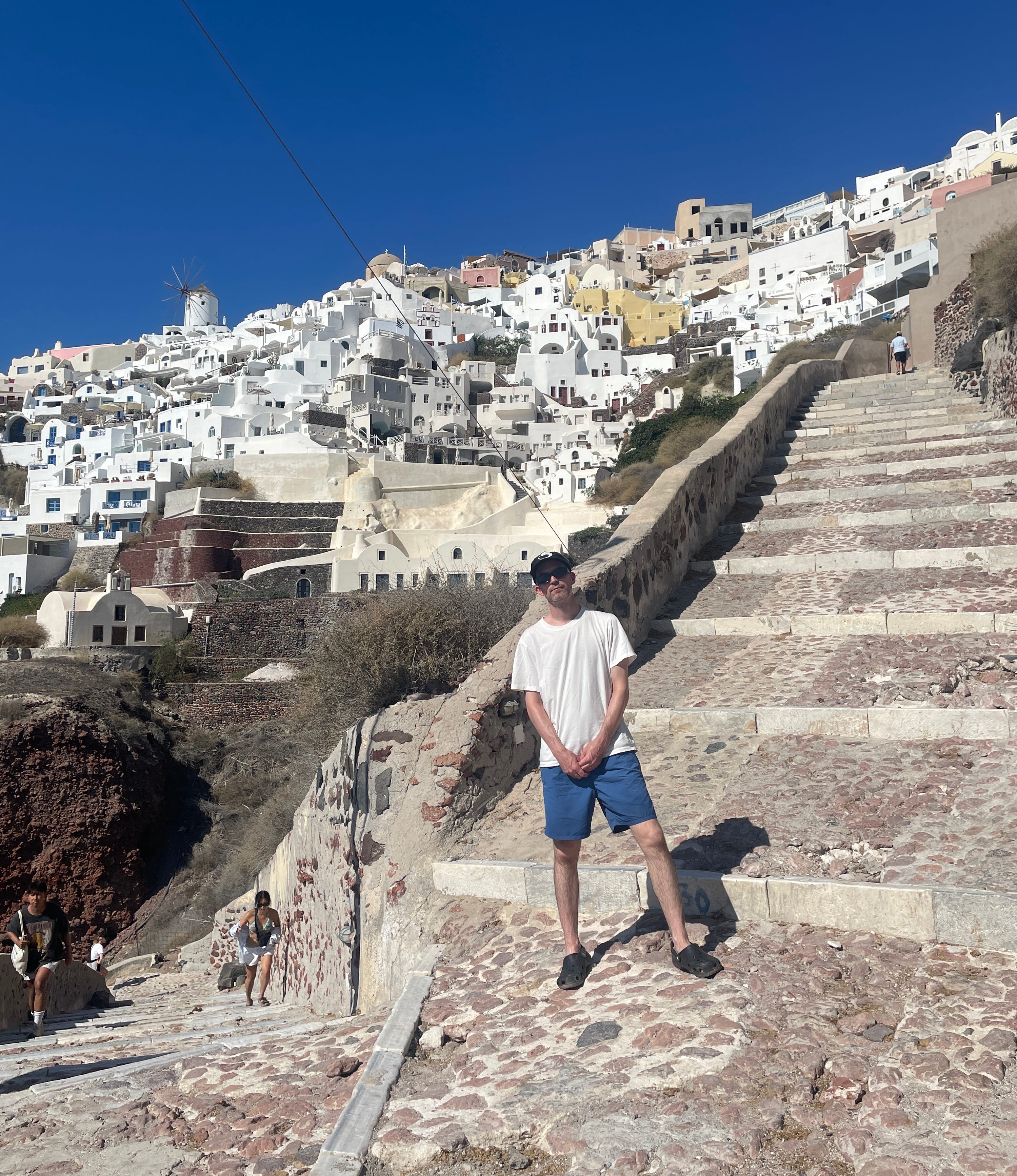
While in Greece, Peisin and I also spent a couple of days on the island of Santorini. Santorini is beautiful but very touristy so it’s not my kind of thing. Like Athens, the island is mostly rock with very little vegetation. It is mountainous. It was shaped by a volcano but in an odd way so, coming from the east side of the island you start at sea level and the elevation gradually goes up, up, up until you reach the west side where the island suddenly falls back to sea level in a sharp, 400 foot cliff. The most densely populated areas of the island exist right on the ridge with many houses, restaurants and hotels built into the face of the cliff. There are three locations on the island where, if you’re adventurous, you can descend the cliff using ancient staircases so, of course, Peisin and I decided to do this. Something interesting about all ancient Greek staircases is that the stairs themselves slope downhill. It is like walking down a steep hill and walking down a staircase simultaneously. Anyway, we woke up early, headed to the Oia Steps and successfully descended the staircase while taking in the beautiful view and avoiding donkeys. There are two ways to go up the stairs, one is by foot and the other is on a donkey’s back. The donkeys are guided by people but if you aren’t paying attention pedestrians can find themselves squished between the wall of the switchback staircase and the side of a donkey’s belly. In any case, we made it unscathed.
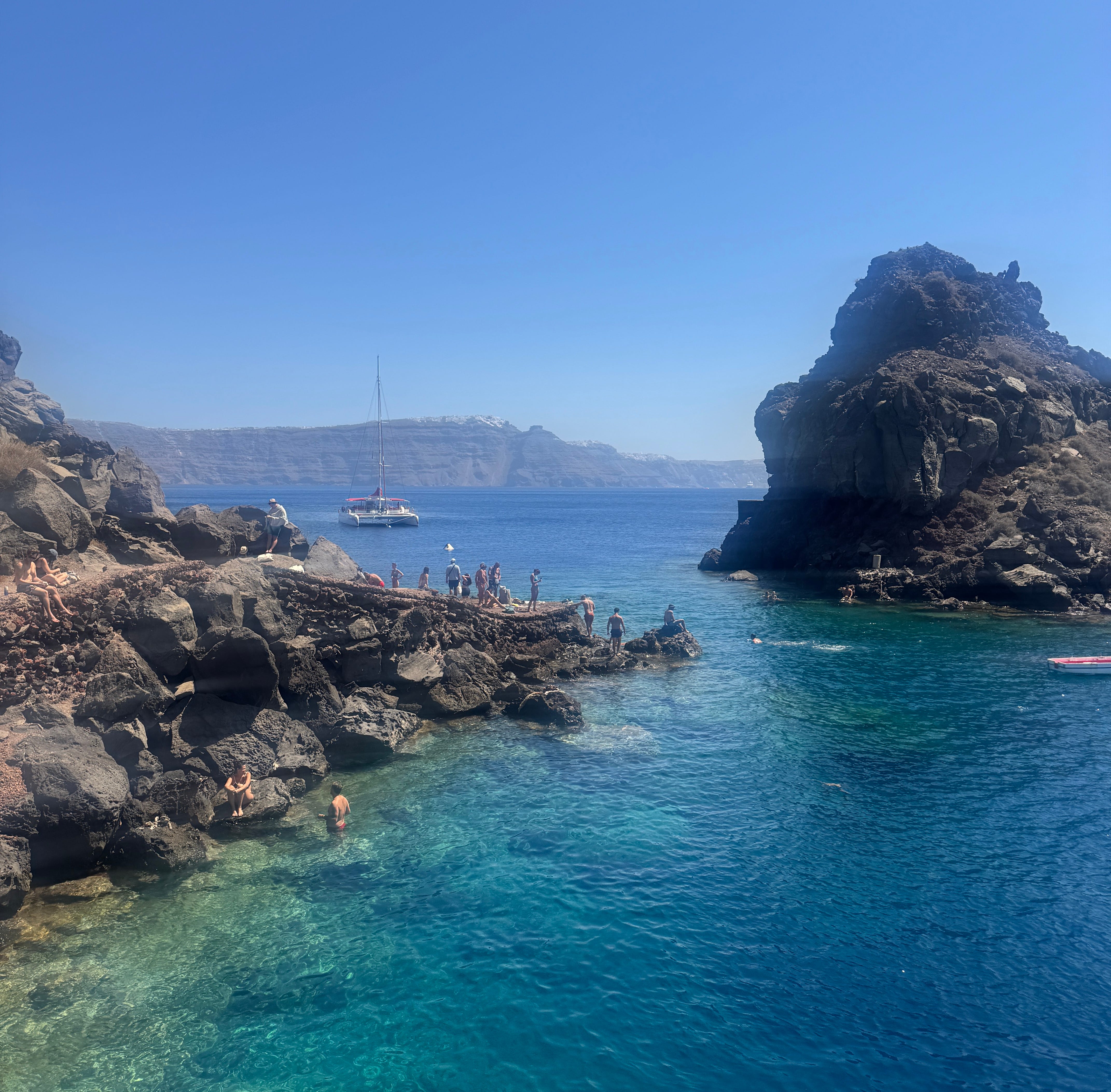
While the bottom of the cliff is largely unsettled, the Oia Steps lead to a boat dock and a handful of restaurants. Peisin and I ate octopus while looking at the bay. After lunch we followed a trail along the water, jumped a fence into a closed off area, walked another quarter mile and reached a secret beach which was not that secret because a bunch of people there. But we took a swim and the water felt fantastic. Kids were snorkeling. A woman spent an hour trying to convince her husband (who was terrified of the ocean) to dive in and when he finally did she had to hold him and it was very cute. We laid out on an ancient wall, which felt magical (but then it turned out there was some jellyfish-like poison that the ocean had spewed on the ancient wall [like an ancient curse!] and Peisin and I ended up getting a terrible rash, but we wouldn’t know that until it appeared days later.) So, basically it was a terrific day…until we got back to the Oia Steps.
The thing about donkeys is they shit wherever they want. So the steps were covered in shit. By this point it was midday, the temperature was in the 90s and the sun was beating down. We had 300 stairs to climb (and with those sloped stairs that’s got to be the equivalent of like 600 stairs!) It was going to be a hot ascent but the one thing we had going for us was a nice, strong breeze. So we got to walking. And everything was going fine. We took a break. We took a few photos. We avoided the donkeys. But halfway up the stairs we encountered a problem. The breeze, which had been so refreshing earlier, was now blasting against the steps and whipping the dried donkey shit into a fury. Little dust devils (or shit devils, if you will) would swirl up in front of us. Sometimes a big gust would send a cloud of dried shit raining down from farther up the switchback. It was nasty. And Peisin started to panic. Peisin and clouds of shit do not get along. When Peisin’s nervous she coughs and by this point she was coughing so hard I thought she was going to bust a lung. But we kept walking and when a big gust hit we would duck for cover. While going down the stairs you could spend your time looking at the ocean but going up the stairs you basically spent all your time looking at the shit. But we kept climbing. And we were sweating. The sun was punishing. We were breathing hard from the climb and shit was blasting us in the face. And Peisin was coughing and coughing but she was kind of holding it together until we got to the Castle Of Oia, which is where the blank face of the cliff ends and the houses begin. It was at this point that Peisin just lost it. She collapsed on the ground in front of the abandoned, decaying castle. She said she was having a heart attack (which she genuinely believed). She said she was going to throw up. Tourists were taking nice pictures of themselves in front of the Oia Castle while Peisin was on her back coughing and dry heaving. I asked her what I could do and she said she didn’t know. She said she had to go to the hospital because of the heart attack and that she was probably already dead. Tourists became frightened of her incessant coughing. I knew there was a little shop around the corner from where we were. I asked Peisin if she wanted me to go buy her water and she said she didn’t want me to leave her side (because she was dying) but that she also did want water. So I ran up a couple flights of stairs and around the corner to the shop. While I was gone Peisin heard a Spanish speaking couple say, “That man just abandoned his sick wife!” When I came back Peisin was propped up, sitting against the wall of the castle. I gave her the water and it was cold and made her feel better. She calmed down a bit. Somehow (through pure power of will!) she was able to stop her own heart attack. We sat there for a couple of minutes, in the sun, covered in shit. Eventually Peisin said she could walk. We ascended the last stairs to the top of the ridge and then made our way back to our hotel where we each took a long shower.
Here’s some notes from Greece that I think are cool but I couldn’t fit into the narrative of the story:
Unlike my trip to Japan (where everyone has a beautiful head of hair) in Athens I found that all the men my age were balding (like me!) so that was comforting.
Peisin and I went to the Athens museum and learned that men used to do the Olympics naked. Full-on dick-out! Bring this back!
When I wanted to read what the anti-capitalist protest was about I translated the wheat pasted sign using google translate which seemed wrong.
In Athens pedestrians do not ever have the right of way. You will die.
No stores are open on Sunday. Except cafes which are all packed.
Very few bugs.
Athens is very hot and businesses have air conditioners but, unlike America, they do not make the room freezing cold. I don’t know exactly what the temp was set to in Greece but it must have been the high 70s. This was perfect! In the United States I need to bring a jacket to the bars on the hottest days of summer to deal with how cold everyone sets their AC. In Japan they also kept the temperature a lot higher than the United States and, for the first time, I’m starting to realize that the United States is wrong and me and Japan and Athens are right! American air conditioning needs to be less cold!
Athens is such a late night town, if I went back I would avoid jet lag by just staying up until 5am every night. It’s so fun in those alley/bar areas. And the temperature is nicer at night. Just sleep all day! This is my recommendation. (Peisin would never let me do this so I would have to go without her)
I found Athens so beautiful that it made me question if New York City was beautiful. Not all of NYC but specifically the places where I’ve spent my time (Lower East Side, old industrial Williamsburg, Bushwick). Exarchia was beautiful AND a cultural center of art. Do we have that in NYC? All the NYC art-culture that matters happens in the ugliest parts of the city. But maybe if someone from Athens came to Bushwick they would find it beautiful???
I just got back from Greece, was in Athens for part of it! Hope you are well old friend :)
i had the best time reading this as someone who lives in Athens. It’s so interesting, being able to see Greece from a foreigners POV. I showed it to my family and we all agreed with every single thing you said!! Thank you so much for sharing!!